
I watched a grower in this region lose thousands of lavender starts in a single freeze because of a name. They called their seed supplier and ordered Spanish lavender, Lavandula stoechas, a hardy evergreen shrub that overwinters here without trouble. The supplier shipped ‘Spanish Eyes’, a cultivar of Lavandula multifida (fernleaf lavender), a completely different species that grows as an annual in our climate. The word “Spanish” was close enough over the phone. After germination the grower realized the seedlings did not look right, but the packaging was gone and they set them out with the rest of their stock to grow on. Then the weather came and finished them off. If that order had gone in as Lavandula stoechas instead of “Spanish lavender,” there would have been nothing to confuse. Thousands of starts, an entire propagation cycle, gone.
Plant names exist to prevent exactly this. Every plant tag you pick up at the nursery contains multiple layers of naming, and each one tells you something different. The Latin identifies the species. The name in single quotes tells you which version you are holding. The name with the ® is marketing. The number at the end is a patent. Of these four, exactly one determines how the plant will perform in your yard, and it is not the one the nursery printed in the biggest font.
The Binomial: Two Words, One Identity
Every plant species has a two-word scientific name. The first word is the genus (a group of closely related species), and the second is the specific epithet (which species within that group). Acer palmatum is Japanese maple. Pseudotsuga menziesii is Douglas fir. Cornus nuttallii is Pacific dogwood. The system has worked since the 1750s for one reason: it is universal. A grower in Oregon, a researcher in Tokyo, and a nursery in Kent are all talking about the same plant when they write Acer palmatum, regardless of what they call it in their own language.
The genus name is always capitalized. The specific epithet is always lowercase. Both are italicized. These are not stylistic choices. They are conventions that signal “this is a scientific name” the same way quotation marks signal dialogue. When you see italicized Latin on a tag or in a catalog, you are looking at the species identity.
Two abbreviations show up regularly. “sp.” (singular) after a genus name means one unspecified species within that genus: Acer sp. could be any maple. “spp.” (plural) means multiple species: Acer spp. refers to maples generally. You will see these on pest management guides and disease references more often than on nursery tags.
Below Species: Varieties, Cultivars, and the Confusion Zone
This is where plant naming gets tangled, and where the confusion costs real money.
A botanical variety (abbreviated “var.”) is a naturally occurring variation within a species. Acer palmatum var. dissectum is the cutleaf Japanese maple. Nature produced it. The “var.” tells you this is a natural subdivision, not something a breeder selected.
A cultivar is a plant selected or bred by humans for specific traits: flower color, disease resistance, mature size, fall color, growth habit. Cultivar names go in single quotes and are not italicized: Acer palmatum ‘Bloodgood’. The single quotes are not optional. They are the internationally standardized marker (governed by the International Code of Nomenclature for Cultivated Plants, now in its ninth edition) that distinguishes a human selection from a natural variety. The cultivar name is the single most useful piece of information on any plant tag because it tells you which specific set of traits you are buying.
A trade name is a marketing label. It carries a ® or ™ symbol and exists because ‘Bailmer’ does not sell hydrangeas. Endless Summer® does. The trade name is not the plant’s identity. It is a brand. The same cultivar can be sold under different trade names in different markets, which is exactly how you end up buying the same plant twice at two different nurseries without realizing it.
A patent number (PP followed by digits, or PPAF for “patent applied for”) means the cultivar is legally protected. You cannot propagate it without a license. For the home gardener, the patent changes nothing about how the plant grows. It matters if you are a grower or a nursery propagating stock. For everyone else, it is background noise on the tag.
Here is the hierarchy, top to bottom:
Hydrangea macrophylla ‘Bailmer’ Endless Summer® (PP15298)
- Hydrangea macrophylla = who it is (species identification)
- ‘Bailmer’ = what version it is (cultivar, the traits you are buying)
- Endless Summer® = what the marketing calls it (trade name, ignore for plant selection)
- PP15298 = patent number (relevant for propagation restrictions only)
The cultivar name stays constant regardless of where or how the plant is sold. The trade name can vary. When you are comparison shopping, the cultivar name is the anchor. If two tags show the same cultivar in single quotes but different trade names, you are looking at the same plant.
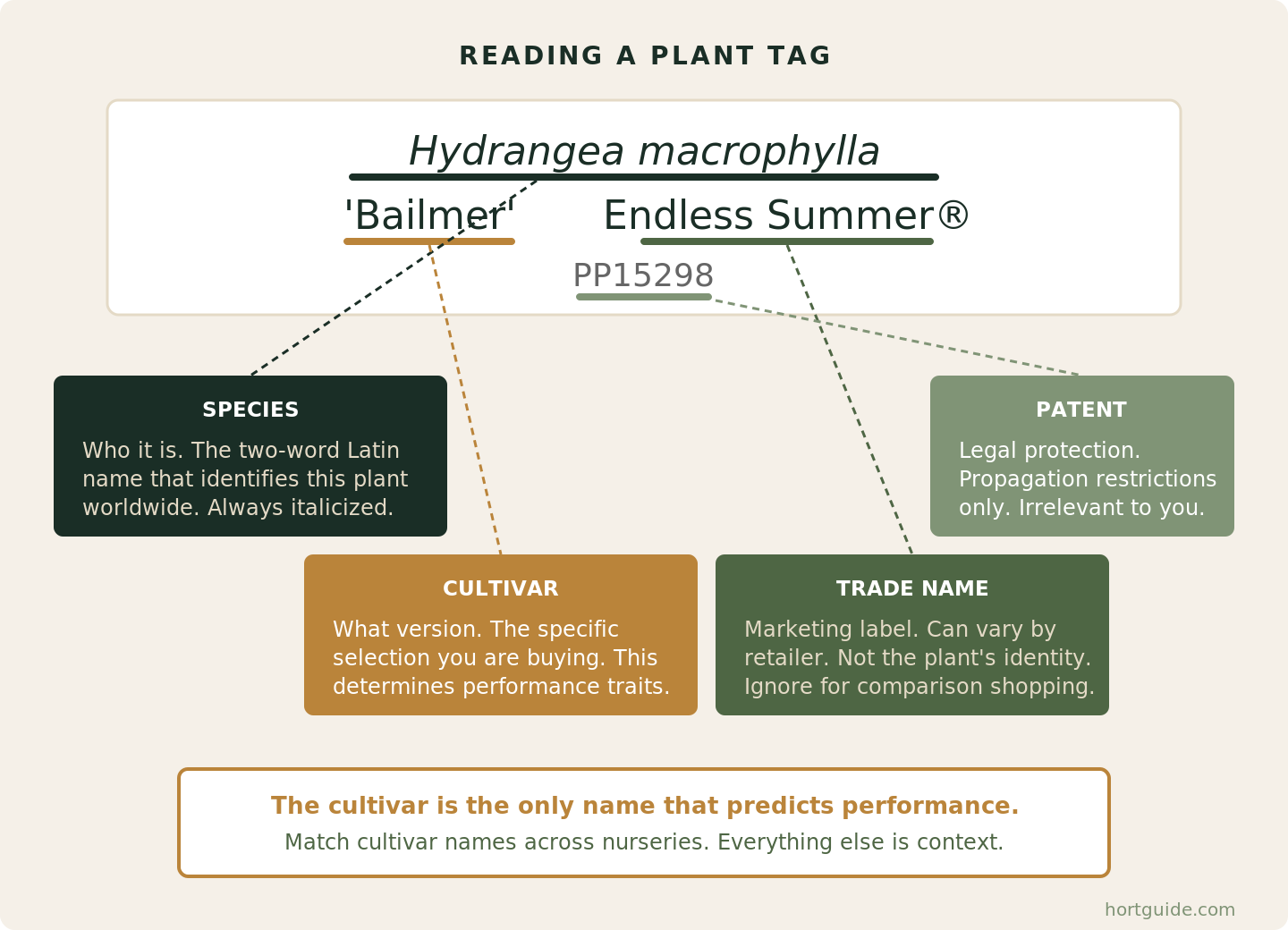
Reading a Tag: Putting It All Together
Next time you pick up a nursery tag, work through it in order.
First, find the italicized Latin. That is the species. If you recognize the genus (Acer, Hydrangea, Cornus), you already know the general family of plants you are dealing with.
Second, find the name in single quotes. That is the cultivar. This is the line that determines mature size, flower color, disease resistance, fall color, growth rate, and every other trait that matters for your site. Two plants with the same species name but different cultivar names can behave very differently in the same yard. Pyrus calleryana ‘Bradford’ splits apart in windstorms. Pyrus calleryana ‘Chanticleer’ does not. The species is the same. The cultivar makes the difference.
Third, note any ® or ™ symbols. That is the trade name. File it for conversation purposes, but do not use it to comparison shop. The cultivar name is what you match across nurseries.
Fourth, if there is a PP number, it means the cultivar is patented. This has no bearing on how you grow it. It matters if you plan to propagate it.
The one thing on the tag that actually predicts how the plant will perform in your garden is the cultivar name. Everything else is either identification (the binomial), marketing (the trade name), or legal status (the patent). When a landscaper recommends a plant or a neighbor shares what worked for them, ask for the cultivar name. It is the only name that travels cleanly from one conversation to another without losing meaning.
Quick Reference
| Tag Element | What It Tells You | Example |
|---|---|---|
| Genus species (italicized) | Species identity | Acer palmatum |
| ‘Cultivar’ (single quotes) | Specific selection, the traits you are buying | ‘Bloodgood’ |
| Trade Name® (with ® or ™) | Marketing label, can vary by retailer | Endless Summer® |
| PP##### | Patent number, propagation restrictions | PP15298 |
Sources
- The Nomenclature of Horticultural Plants -NC State Extension Gardener
- What’s in a Name? Reading Plant Labels -OSU Extension
- ICNCP: International Code of Nomenclature for Cultivated Plants -International Society for Horticultural Science
- Plant Names -Missouri Botanical Garden