
You notice it in May. Olive-green spots on the upper surface of your apple leaves, each one the size of a pencil eraser, with edges that look a little smoky. By June the spots have darkened to brown-black, the worst leaves are curling, and a few have already dropped. On the fruit, raised corky patches are forming, each one ringed by a torn edge of skin. The tree looks progressively worse through July, and by August the ground underneath is littered with spotted leaves while the fruit hanging above carries dark, rough scabs that crack the skin as the apple enlarges.
This is apple scab, caused by the fungus Venturia inaequalis, and in the Puget Sound lowlands it is the most reliable fungal disease on any Malus species. Western Oregon data from 1989 to 2001 recorded an average of eight infection periods per year, each lasting nearly 29 hours. That is not occasional risk. That is a near-guarantee for any susceptible variety growing in a maritime climate with our kind of spring.
The good news: apple scab is entirely manageable. Whether you are growing Honeycrisp for the kitchen or maintaining a row of ornamental crabapples on a commercial property, the tools are the same: choose the right cultivar, clean up the leaves in fall, and if you spray, understand the difference between a protectant and a kickback fungicide. Each one works best in a specific order.
What You Are Looking At
Scab symptoms progress through a predictable sequence. The earliest infections appear 8 to 15 days after a spring rain event, starting as pale, water-soaked spots barely the size of a pinhead. These are easy to miss. Within a few days the spots enlarge and develop a distinctive olive-green color with a velvety texture, the surface of millions of fungal spores (conidia) growing on the leaf.
On leaves, the spots darken to brown-black as they age. They are usually circular, often appearing on only one side of the leaf during the growing season. Heavily infected leaves curl, distort, and drop early, sometimes defoliating the tree by midsummer.
On fruit, scab starts as small raised circular areas, brown to black, with no skin break. As the apple grows, the skin over the spot ruptures and the exposed tissue takes on that rough, corky texture that gives the disease its name. Late-season infections can remain invisible until fruit is in storage, where black circular lesions develop, sometimes called pinpoint scab.
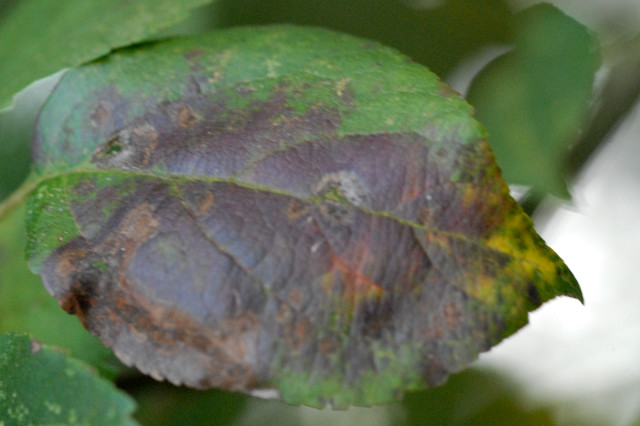
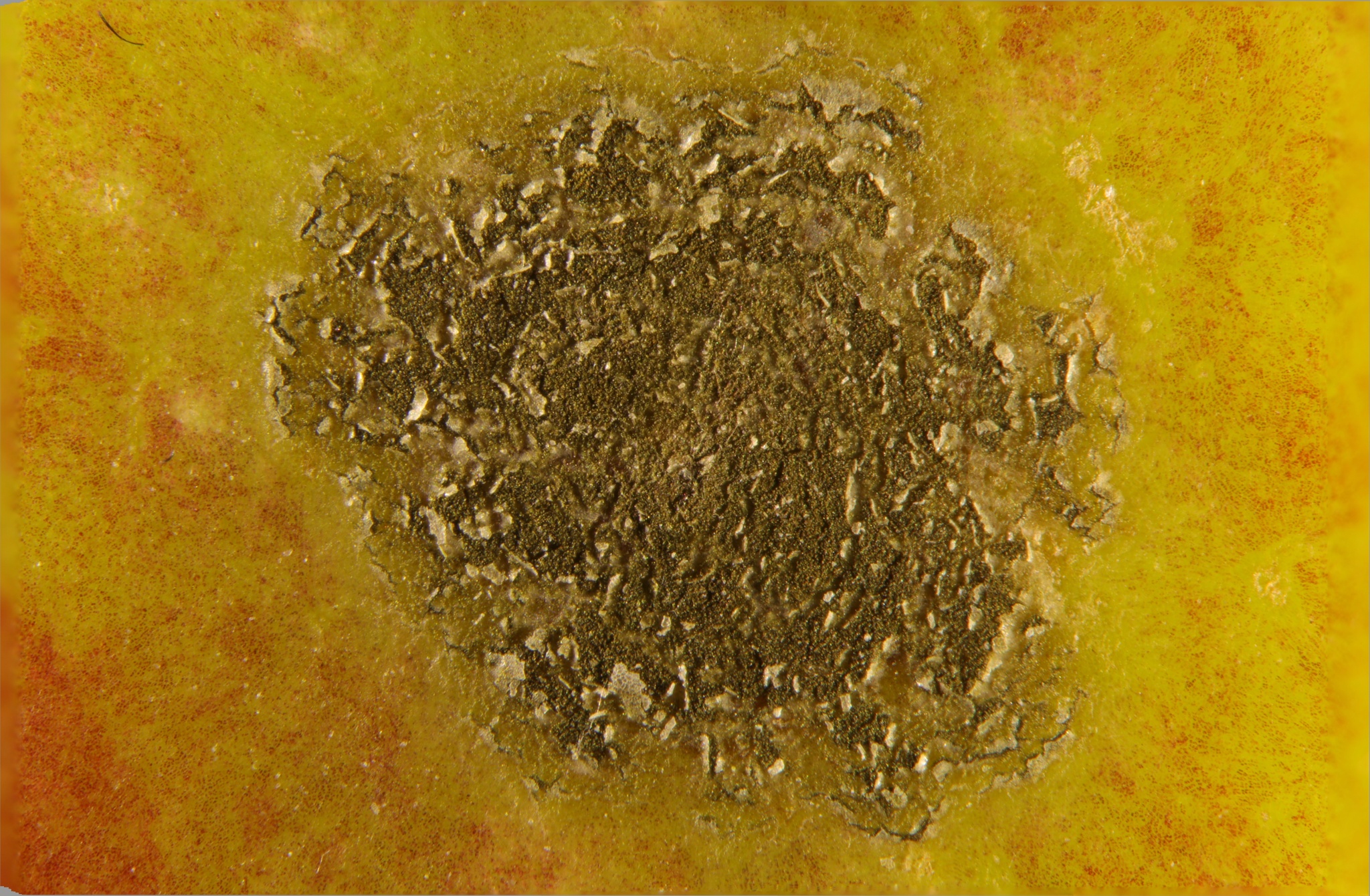
What it is not. Sooty blotch and flyspeck are surface-only fungi that wipe off with a damp cloth; scab is embedded in the tissue and cannot be rubbed away. Cedar-apple rust produces bright orange spots with gelatinous horns on the underside, nothing like scab’s olive-to-black progression. Anthracnose creates irregular brown patches often following leaf veins, while scab spots are typically circular and well-defined.
Why Wet Springs Are the Problem
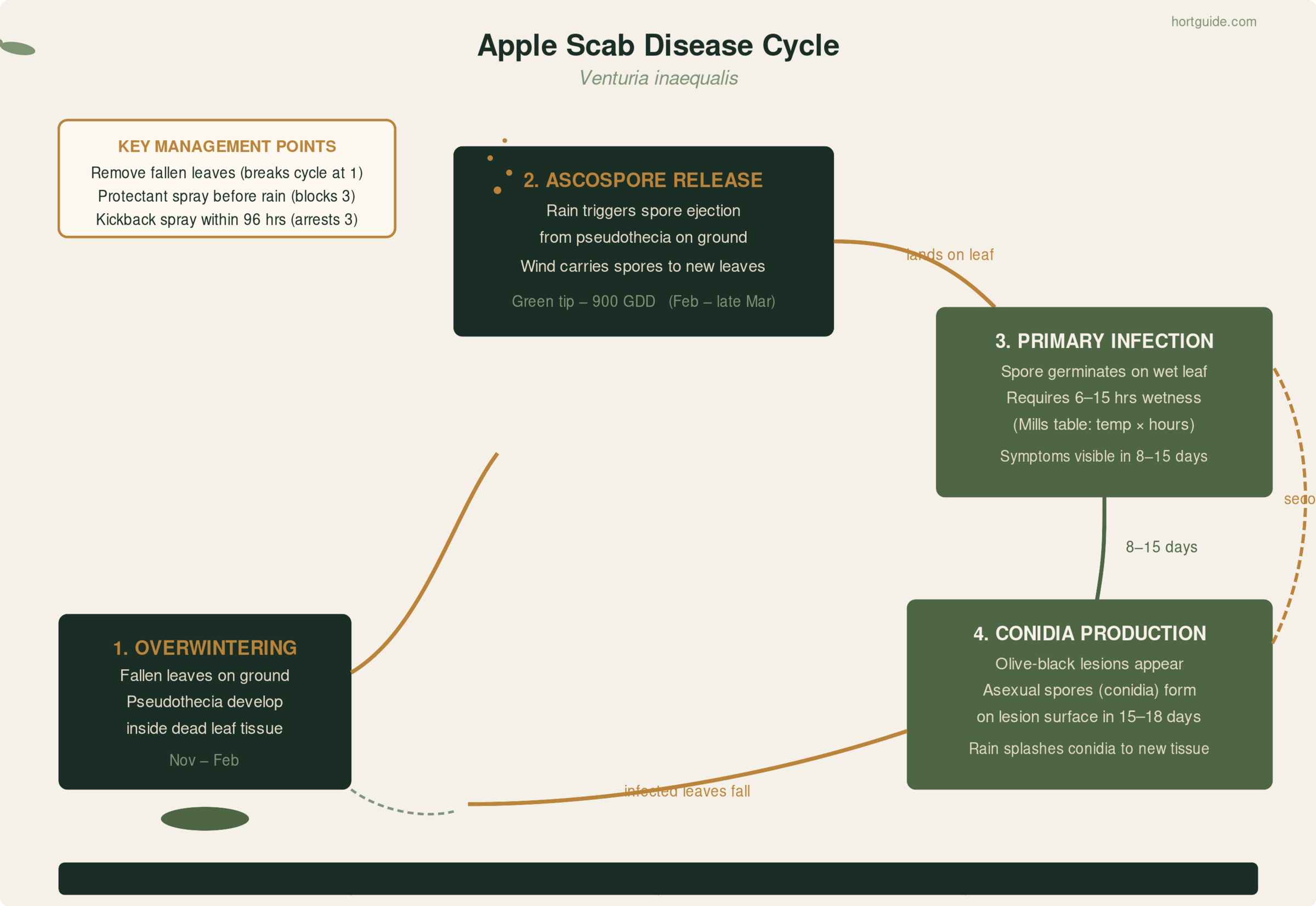
The fungus overwinters in dead apple leaves on the ground. Over the winter, black flask-shaped fruiting structures called pseudothecia develop inside that leaf litter. When spring arrives with rain and warming temperatures, each pseudothecium produces sexual spores (ascospores) that are forcibly discharged into the air. Wind carries them to emerging leaves and flowers.
Even a well-managed orchard with only 1 percent leaf scab the previous year still produces roughly 900,000 ascospores per acre. Complete elimination of the fungus is not realistic. The goal is to reduce the inoculum below the damage threshold.
Primary ascospore release begins at green tip, the moment you can see the first sliver of green leaf tissue emerging from the buds, and continues for four to six weeks, through about two to three weeks past petal fall. In the Puget Sound lowlands, that window runs from approximately late February through late March at current GDD accumulation rates. All seven stations in the HFG weather network passed 900 GDD base 32°F by late March 2026.
Once ascospores land on a wet leaf surface, infection depends on two things: temperature and how long the leaf stays wet. This relationship is called the Mills table, the foundational decision-support tool for scab management since 1944. MacHardy and Gadoury revised it in 1989, finding that ascospores need about three hours less than Mills originally calculated.
The temperature-wetness ranges that matter here:
| Temperature | Wetting Hours for Infection |
|---|---|
| 45-50°F | 12-15 hours |
| 51-60°F | 6.5-11 hours |
| 61-75°F | 6 hours (minimum) |
Most Puget Sound spring rain events deliver 10 or more continuous hours of leaf wetness at temperatures between 50 and 60°F. A typical March or April rain here is not “might cause infection” but “almost certainly will if susceptible leaves are present.”
After infection, symptoms become visible in 8 to 15 days. The infected tissue then produces asexual spores (conidia) in another 15 to 18 days. These conidia splash to new leaves via rain, starting secondary infection cycles that continue through every wet period until the leaves drop in fall. The primary ascospore season has a defined end; the secondary season does not.
Who Gets Hit
Apple scab attacks Malus species: fruiting apples and ornamental crabapples. If you grow either, this is your concern. The fungus can also infect hawthorn (Crataegus spp.) and, less commonly, firethorn (Pyracantha) and cotoneaster, though these hosts are affected by related Venturia species rather than V. inaequalis itself.
Fruiting apples fall into three practical categories for this region:
Rarely need spraying (scab rating 1, very resistant): Liberty, Prima, Redfree. These carry genetic resistance that holds up reliably in maritime conditions. Liberty in particular has been a strong performer in the Puget Sound lowlands for decades.
Spray only in high-pressure years (rating 2, resistant): Enterprise, Honeycrisp, Pristine, Chehalis. The majority of home growers here are growing Honeycrisp, and the good news is that it carries genuine resistance. You may see a few leaf spots in a very wet spring, but consistent fruit damage is unlikely without extreme disease pressure. Pristine and Enterprise also resist both scab and powdery mildew, making them the lowest-maintenance choices for this region.
Expect scab every year without a spray program (ratings 3-4, susceptible to very susceptible): Gala, Red Delicious, McIntosh, Fuji, Gravenstein, Granny Smith, Rome Beauty, Empire, Cortland, Cripps Pink. These are the varieties most commonly sold at nurseries and garden centers. If you already have one of these in your yard, the cultural management and spray timing sections below are written for you.
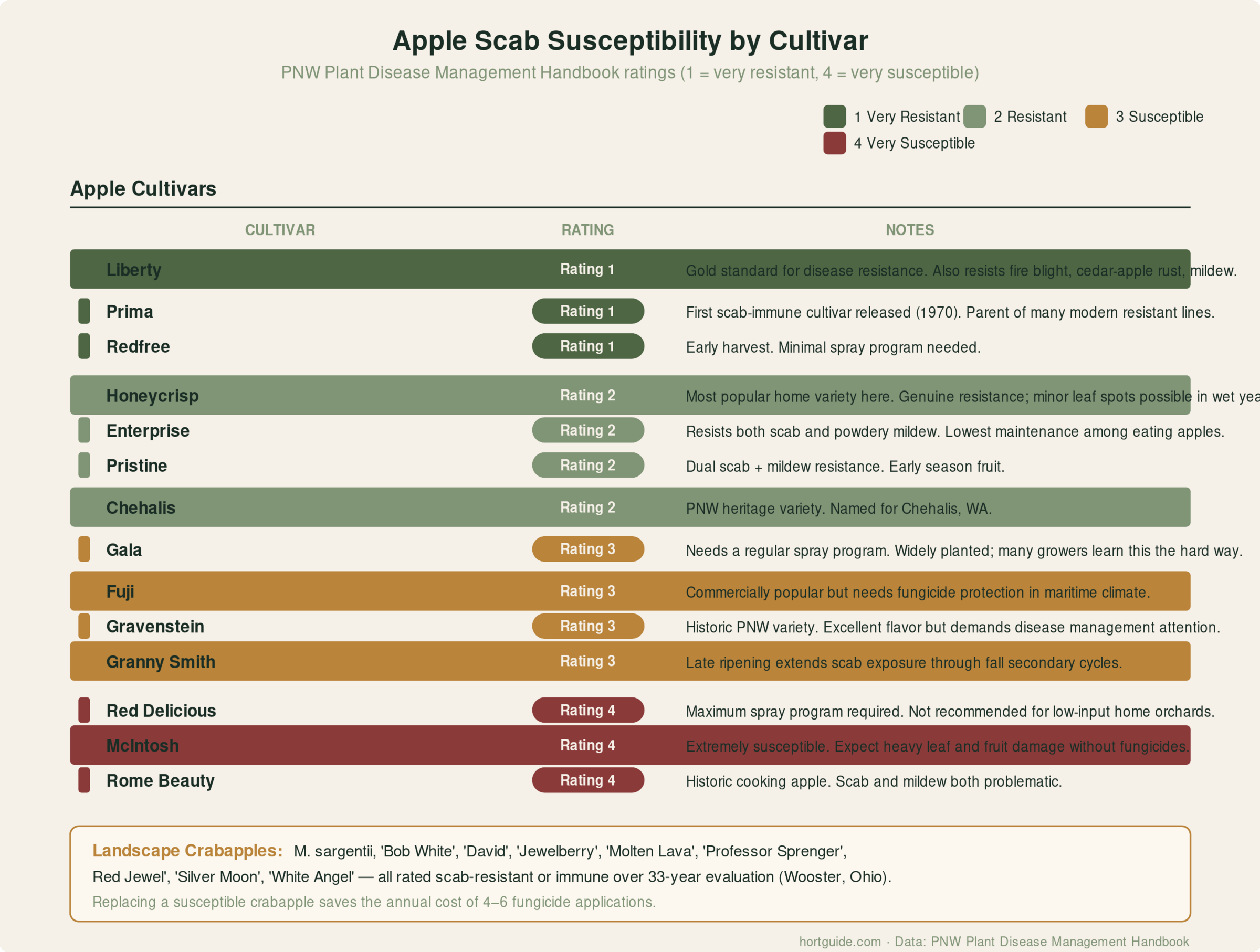
Ornamental crabapples vary just as widely. Resistant landscape selections include Bob White, David, Jewelberry, Molten Lava, Professor Sprenger, Red Jewel, and Malus sargentii. A 33-year evaluation at Wooster, Ohio found that M. sargentii ‘Sargent’, M. baccata ‘Jackii’, M. × ‘Beverly’, M. × ‘Silver Moon’, and M. × ‘White Angel’ never developed scab over the entire study period.
If you have a susceptible crabapple that defoliates every July, replacing it with a resistant cultivar costs less than a single season of fungicide applications.
Fall Sanitation: The Single Most Effective Practice
Every ascospore that infects your tree next spring came from a dead leaf that spent the winter on the ground underneath it. Reducing that leaf litter is the one cultural practice that compounds year over year: fewer leaves this fall means fewer ascospores next spring, which means less secondary infection next summer, which means fewer infected leaves to drop next fall.
In continental climates, winter freezing and dry conditions reduce the viability of leaf litter naturally. The Puget Sound lowlands offer no such help. Our wet winters keep the litter moist, which actually accelerates the development of pseudothecia inside the leaves. Fall sanitation is more critical here than in most apple-growing regions.
For home gardeners: Rake and remove fallen apple and crabapple leaves in October and November. Bag them for yard waste collection or hot-compost them. If they go into a compost pile, make sure the pile reaches temperatures high enough to kill the fungus; a passive pile will not do it.
For larger properties and landscape professionals: Run a flail mower over the leaf litter to shred it. Shredding dramatically accelerates decomposition. Follow with an application of 5 percent urea (46-0-0 fertilizer dissolved in water) plus a surfactant to the remaining litter and soil surface. This nitrogen boost makes the leaf fragments more attractive to earthworms and soil microbes, speeding breakdown further. The organic equivalent is yucca extract (Organic Wet Betty) or 30 percent yeast extract as the surfactant.
Applying dolomitic lime after leaf drop raises the soil pH at the litter surface, creating conditions less favorable for pseudothecia development.
For a single tree: UC Davis research notes that leaf removal and composting alone can reduce disease to tolerable levels on one backyard apple tree. The calculus changes with multiple trees: more canopy means more litter, and the sanitation effort scales faster than you expect.
Site and Cultural Practices
Beyond fall cleanup, a few planting and management decisions reduce infection pressure:
Full sun and air circulation. Scab needs leaf wetness. A tree in full sun with open canopy structure dries faster after rain than a crowded tree in partial shade. Space trees adequately and prune to maintain air flow through the canopy.
Avoid overhead irrigation. Drip or under-canopy irrigation keeps foliage dry. If you must use overhead sprinklers, run them between sunrise and noon so leaves dry before evening. Extended overnight wetness is exactly the condition that drives infection.
Pruning hygiene. While scab is not typically spread by pruning tools the way fire blight is, removing congested interior branches improves drying and spray penetration.
Chemical Management: Timing Is Everything
Two classes of fungicide work against apple scab. They function differently, and choosing the wrong one at the wrong time wastes product and misses the disease.
Protectant fungicides must be on the leaf surface before an infection event. They prevent spore germination on contact. Once rain washes the product off or new unprotected growth emerges, coverage is gone. Products in this category include captan (10-day protection), sulfur (5-7 days), chlorothalonil (Bonide Fung-onil, GardenTech Daconil), and copper. The 7-day spray interval recommended by WSU HortSense reflects the need to maintain continuous protectant coverage during the vulnerable window.
Kickback (systemic) fungicides are absorbed into the leaf tissue and can arrest an infection that has already started, but only within a narrow window after spore germination. Myclobutanil (ferti-lome F-Stop, Spectracide IMMUNOX) and propiconazole (Bonide Infuse Systemic) provide 36 to 96 hours of post-infection activity, depending on the product and conditions. After that window closes, the infection is established and no fungicide will stop it.
Most home gardeners spray reactively: they see spots, then reach for a product. By that point, protectants are useless because the infection happened 8 to 15 days earlier. Only a kickback fungicide applied within two to four days of the rain event that triggered infection would have helped. If you missed that window too, you are spraying for the next rain event, not the one that already caused damage.
Spray timing for fruiting apples:
Begin at green tip (first visible leaf tissue emerging from buds). Apply a protectant before the first spring rain. Repeat on a 7-day interval through bloom and as long as wet weather continues. If you miss a protectant application and it rains, you have 36 to 96 hours to apply a kickback fungicide before that infection is established.
Spray timing for ornamental crabapples:
Apply at pre-pink, pink, and calyx stages. If scab was a problem the previous year, start at green tip. Crabapple scab is cosmetic, not economic, so the threshold for spraying is higher. Many landscape professionals skip spraying entirely on resistant crabapple cultivars and accept minor leaf spotting in wet years.
Organic options:
Lime sulfur provides the longest post-infection window of any organic product: 60 to 70 hours. Apply it before rain for protectant activity or within 60 hours after for kickback. It is phytotoxic within 7 to 10 days of a horticultural oil application, so do not combine these products in the same spray window.
Copper fungicides provide roughly 7 days of protectant coverage. Apply between silver tip and quarter-inch green tip for early-season scab prevention. Avoid copper between half-inch green and bloom because it causes fruit russeting.
Sulfur (5-7 day protection) is the workhorse organic protectant. Potassium bicarbonate (Kaligreen, MilStop) has no post-infection activity but can supplement sulfur in a rotation. Bacillus subtilis (Serenade) is labeled for scab with modest efficacy, best used as part of a rotation rather than as a standalone treatment.
Resistance management: Rotate between fungicide classes to prevent the scab population from developing resistance. Alternating between a protectant (captan or sulfur) and a systemic (myclobutanil) within the same season is standard practice.
Seasonal Management Calendar
| When | What | Who |
|---|---|---|
| Oct - Nov | Rake/remove or flail-mow fallen leaves. Apply 5% urea + surfactant to remaining litter. Apply dolomitic lime after leaf drop. | All |
| Dec - Feb | Assess previous year’s severity. Plan spray program for susceptible cultivars. Consider replacing chronically defoliated crabapples with resistant selections. | All |
| Green tip (Feb - Mar) | Begin protectant spray program on susceptible cultivars. Copper or lime sulfur for organic programs. | Fruit growers |
| Pre-pink through bloom | Continue 7-day protectant intervals. No copper during bloom (russeting risk). Switch to sulfur or captan. | Fruit growers |
| Post-bloom | Reduce spray frequency during dry weather. Resume intervals when rain returns. | Fruit growers |
| May - Aug | Monitor for secondary infections on new growth. No action needed on resistant cultivars. | All |
| Anytime | Evaluate whether a susceptible crabapple should be replaced with a resistant cultivar. One planting decision eliminates a recurring annual cost. | Landscape |
Disclaimer: All disease management recommendations are drawn from WSU HortSense, the PNW Plant Disease Management Handbook, and field observations specific to the Pacific Northwest, Zone 8b. Always read and follow pesticide label directions. Product registrations change; verify current Washington state registration before purchasing.
Sources
Regional extension:
- PNW Plant Disease Management Handbook: Apple Scab
- PNW Handbooks: Apple Cultivar Susceptibility Table
- WSU Extension: Apple Scab
- OSU Extension PNW-582: Apple Scab
Non-PNW extension:
- UC Davis IPM: Apple Scab (Agriculture)
- [UC Davis IPM: Apple and Pear Scab (Home and Landscape)](https://ipm.ucanr.edu/home-and-landscape/apple-and-pear-scab/)
- University of Minnesota Extension: Apple Scab
- UMass Amherst: Apple Scab Infection Periods
- Purdue University: Apple Scab and Ascospore Maturity
Research:
- Gadoury, D.M. & MacHardy, W.E. 1982. “A model to estimate the maturity of ascospores of Venturia inaequalis.” Phytopathology 72:901-904. DOI: 10.1094/Phyto-72-901
- MacHardy, W.E. & Gadoury, D.M. 1989. “A revision of Mills’ criteria for predicting apple scab infection periods.” Phytopathology 79:304-310.
Decision support: